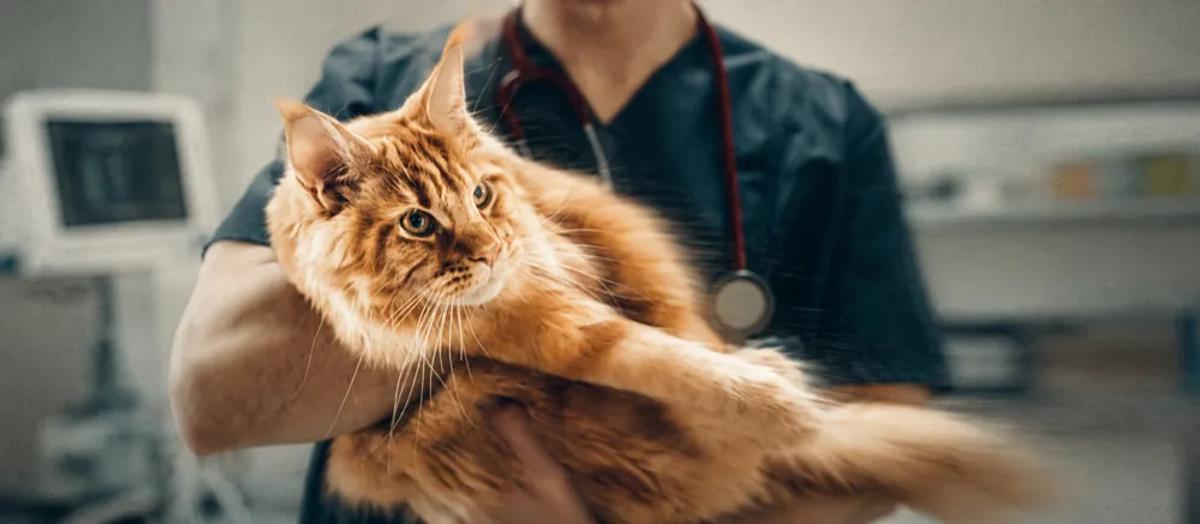
A cat in India needs two core protections from the vet: the FVRCP vaccine and a rabies shot. FVRCP covers the three infections that hit cats hardest, and rabies matters because India carries a large share of the world's human rabies deaths. Kittens begin at six to eight weeks and finish the first course at sixteen weeks or later, with one more dose after that. Get those in place and you have covered nearly everything that genuinely threatens a cat's life in an Indian home.
Each section below links to a deeper guide, on the kitten schedule, rabies and the law, the FVRCP combination, and how the shots are sorted into core and non-core.
At a glance, for a healthy cat in India:
- 6 to 8 weeks: first FVRCP, and never earlier than six weeks.
- Every 3 to 4 weeks after that: repeat FVRCP.
- From three months of age: first rabies shot.
- 16 weeks or older: final kitten FVRCP, the dose that matters most.
- 26 weeks or older: the follow-up core dose that closes out the kitten course.
- Adult, low risk: core FVRCP at three years of age, then no more often than every three years. Rabies on whatever your local rules set, or failing that on the product leaflet, which for the leaflet used here means a yearly booster in an endemic country like India.
Why cats in India need these shots
Two facts sit behind the whole schedule.
The first is rabies. The World Health Organization puts India at roughly 36% of the world's human rabies deaths transmitted by dogs, and its rabies fact sheet is blunt about the disease itself: once clinical symptoms appear, rabies is virtually 100% fatal. It infects mammals broadly, cats included. India's national plan is aimed at dogs, and the National Guidelines on Rabies Prophylaxis put dogs behind about 97% of human rabies here, with cats behind about 2%. So a cat sits at the edge of that picture rather than the centre of it. A cat that slips outside, or lives in a building full of community animals, is still inside it.
The second is feline panleukopenia. It is a parvovirus, and the European Advisory Board on Cat Diseases is blunt about the prognosis: fewer than half of the cats that fall ill with it survive, even with intensive care. The illness brings diarrhoea, a collapsing white-cell count, anaemia, and in kittens the wobbling, uncoordinated walk of cerebellar damage. The virus survives months in the environment and travels indoors on shoes and clothing, so an indoor-only cat is not out of its reach. The World Small Animal Veterinary Association (WSAVA) reported on Asian practice in 2014, from fieldwork carried out in 2012 and 2013: 71 per cent of the 144 Indian practitioners surveyed reported seeing feline parvovirus in their practice. Alongside it sit the two viruses behind cat flu, feline herpesvirus and calicivirus. Neither has a quick cure once a cat is sick, and that is the whole case for the vaccine.
Core vaccines, and the ones that depend on your cat
Vets sort cat vaccines into two groups, and the split decides what your cat actually needs.
Core vaccines are the ones every cat gets, indoors or out. WSAVA's 2024 global guidelines name three as core for cats everywhere: panleukopenia (FPV), feline herpesvirus (FHV) and calicivirus (FCV). Those three are what the FVRCP combination shot contains. In a rabies-endemic country like India, rabies is core as well.
Feline leukaemia, FeLV, is the one genuine middle case, and the detail people miss is that its status is regional. WSAVA designates FeLV vaccines core in the parts of the world where FeLV-related disease is known to occur, and inside those regions the designation covers cats under a year old plus older cats that either go outdoors themselves or live with cats that do. A settled indoor adult with no roaming housemates falls outside it. A blood test comes first either way, because the vaccine only helps a cat that is not already carrying the virus.
Everything else is genuinely optional, brought in for narrow situations. Which of those your own cat needs is a question the guide to core versus non-core cat vaccines answers case by case.
What the core vaccines protect against
- Panleukopenia (FPV): a feline parvovirus that fewer than half of the cats who fall ill with it survive, even with intensive care. This is the P in FVRCP and the reason the shot exists.
- Feline herpesvirus (FHV): the agent of feline viral rhinotracheitis, an acute upper respiratory and ocular disease whose typical signs start with salivation and sneezing and go on to fever, low spirits and a cat off its food. After recovery the virus stays latent for life and can reactivate under stress.
- Feline calicivirus (FCV): the other half of cat flu, known for painful erosions in the mouth, typically on the tongue.
- Rabies: virtually 100% fatal once symptoms appear, and it passes to people through saliva, usually via a bite or a scratch.
The schedule, from first shot to adult booster
Kittens take in antibodies from their mother's first milk in the first hours of life, and that borrowed protection fades across the first few months. While it lasts it can also block a vaccine from taking properly. Nobody can pinpoint the week it runs out in any individual kitten, which is why the course runs to several doses spread weeks apart.
WSAVA's feline protocol starts the core trivalent vaccine at six to eight weeks and repeats it every three to four weeks until the kitten is at least sixteen weeks old. That final dose carries the most weight, because by then the borrowed antibodies have usually gone and the vaccine can do its job. A further dose follows at twenty-six weeks or older. The first rabies shot comes from three months of age. WSAVA's feline tables name no age for rabies at all; they defer to local regulation, and where there is none, to the product leaflet. In India that leaflet is the one to read: MSD's Nobivac Rabies, sold here for dogs and cats alike, gives the primary dose after three months of age.
WSAVA sets the core list at species level: core vaccines are the ones all cats should receive, and the factors it names as shaping a plan are lifestyle and the geography a cat lives in. A Persian follows the same core series as an Indian domestic shorthair. What actually shifts the plan is your cat's age at the first shot and how much it mixes with other cats.
For adults, WSAVA revaccinates a low-risk cat with the core vaccine at three years of age and then no more often than every three years. Rabies runs on its own clock: local regulations first, and where there are none, the product leaflet. Nobivac Rabies puts revaccination at three years, with a footnote recommending annual revaccination in endemic areas, and India is endemic, so a year is the interval that applies here. Higher-risk cats can go more frequently, up to annually, and a cat heading into a boarding cattery should have its shot one to two weeks before it goes in. Those first months have their own page, the week-by-week kitten schedule.
One thing worth knowing before you ask your vet about intervals. WSAVA's position is that its guidelines are guidance for decision-making and do not set mandatory or minimum standards of care, and it expects national and regional associations and individual practices to build their own schedules around local conditions. So it is fair to ask your vet which schedule they follow and why.
Rabies and the law: what is actually required for a cat
Plenty of pet pages treat a rabies shot as a legal must for every cat in India. Go looking for the instrument behind that and it is not there. The Animal Birth Control Rules, 2023, notified as G.S.R. 193(E) on 10 March 2023, do place deworming, immunisation and sterilisation on an animal's owner under Rule 8(1). The catch sits one rule earlier. Rule 7 defines "pet animals", for the purposes of those Rules, as dogs owned and kept indoor by individuals. A cat falls outside that definition, so the owner duty never reaches it.
Cats do get one rule of their own, and it changes nothing for an owner. Rule 19 is headed "Sterilisation and Immunisation of Domestic or Feral cats", and what it provides is that a recognised animal welfare organisation may sterilise cats on the advice of the State Board, in the manner set out in Guidelines for Cat Sterilisation and Immunisation published by the Animal Welfare Board of India. It speaks to welfare organisations and to the local authority that funds them, not to you. And those Guidelines are not on the Board's published list of guidelines, which leaves the immunisation named in that heading with no procedure attached to it.
That leaves you with a health decision. The health answer is not ambiguous: WSAVA recommends rabies vaccination for all cats in regions where the disease is endemic, explicitly including places where legislation does not require it for cats. Municipal bye-laws are the one layer that can change the answer. Two that name cats are worth knowing about. Aizawl requires a dog or cat over three months of age to be registered, and requires the owner to vaccinate it against rabies and produce proof at registration. Mohali, whose bye-laws carry the city's official name of Sahibzada Ajit Singh Nagar, counts a cat as a registrable animal and makes vaccination the owner's responsibility, though it never names rabies inside that duty. Whether your own city has a bye-law of this kind is something only your municipality can tell you. The full legal detail sits in the rabies guide for cats.
Reading FVRCP on the vaccination card
Your cat's card will usually say FVRCP, sometimes 3-in-1 or tricat. Five letters, three viruses. FVR is feline viral rhinotracheitis, the disease feline herpesvirus causes. C is calicivirus. P is panleukopenia.
You will also see cards and clinic price lists marked 4-in-1 or 5-in-1. Those numbers are brand and clinic shorthand, not veterinary classifications. WSAVA's guidelines define the feline core product as the trivalent FPV, FHV and FCV vaccine and do not define any feline 4-in-1 at all, so the reliable way to know what went into your cat is to read the component names printed on the vaccine sticker your vet peels onto the card.
One mix-up is worth naming. The P is panleukopenia, not leukaemia. Feline leukaemia is FeLV, a separate virus with a separate vaccine and a blood test that has to come first. Reading a card properly is fiddlier than it sounds, and the FVRCP explainer is the longer version.
Finding a low-cost route
Start with the government network. Your state veterinary hospital, your nearest veterinary college clinic and your municipal veterinary department are each worth a phone call, and the last of those is the one to ask about anti-rabies vaccination drives and when the next one runs. At the policy end, the Central Government is implementing a scheme for birth control and immunization of stray dogs and stray cats whose stated objective is to reduce zoonotic disease by immunisation, with anti-rabies vaccination for stray cats inside the funded package and the money reaching SPCAs and local bodies through the Animal Welfare Board of India and the State Animal Welfare Boards. That scheme covers community animals, so it will not pay for your own cat's shot. It does tell you the machinery exists in your district.
On price, any figure published online is close to useless to you. Vaccine cost swings by city, by clinic and by brand, and the only number that applies to your cat is the one your own vet quotes. Ask for it up front, and ask whether the consultation is billed on top.
What to expect after the shot, and what to write down
Most cats are fine. Pain or swelling where the needle went in, a day of tiredness, a smaller appetite, sometimes a mild fever: WSAVA lists all of these as commonly observed. Hives and anaphylaxis do happen and are the uncommon end of the range. WSAVA reports the figure from a study by Moore and colleagues: adverse reactions of any kind, including the very minor ones, documented within thirty days of vaccination in fifty-two of every ten thousand cats vaccinated.
The thing to keep an eye on is a lump. There is a specific rule here rather than a vague one. A post-vaccination mass that is still present three months on, or larger than two centimetres at any point, or still growing a month after the shot, should be biopsied. That rule exists because feline injection-site sarcoma exists, and WSAVA is equally clear that any risk of it is far outweighed by the protection the vaccines give.
Which is a good argument for writing things down. Ask your vet to record the injection site on the card alongside the date, because WSAVA asks for exactly that and a future vet will want it. Cards also get lost. Photograph yours, note the next due date the day the shot is given, and if you would rather not carry it in your head, Nuzzy's PetLife holds the reminders and the history while PetID keeps a QR-linked record that travels with your cat to any vet or boarder. If a society or a boarder asks you for proof, the guide to responding to a society pet notice covers that exchange.
Frequently asked questions
Which vaccinations are compulsory for cats in India?
No national law names any vaccine as compulsory for a pet cat. Veterinary guidance is a different matter, and it points to two: the core FVRCP combination and rabies. FeLV is added where FeLV disease occurs locally, for kittens and for cats with outdoor access, after a blood test.
How often does an adult cat need boosters?
WSAVA revaccinates a low-risk adult cat with the core vaccine at three years of age, then no more often than every three years. Rabies follows local regulations, or where there are none, the product leaflet. The leaflet used here recommends annual revaccination in endemic areas, and India is endemic. Ask your vet which schedule they follow.
Is rabies vaccination legally required for pet cats?
Not nationally. The Animal Birth Control Rules, 2023 put immunisation on an owner, but Rule 7 defines "pet animals" for the purposes of those Rules as dogs owned and kept indoor by individuals, so a pet cat falls outside that duty. Municipal bye-laws can go further. Aizawl asks for proof of rabies vaccination when a cat is registered, and Mohali treats a cat as a registrable animal with vaccination as the owner's responsibility. WSAVA classes rabies as core for cats in areas where the disease is endemic, and India qualifies, so the clinical case for the shot stands whatever the law says.
Do Persian cats need different vaccinations?
No. WSAVA sets its core list at species level, naming lifestyle and geography as the factors that shape a plan, so a Persian follows the same core FVRCP and rabies schedule as any other cat in India. What changes the plan is the age your cat starts at and how much it meets other cats.
How much does cat vaccination cost in India?
It varies too much by city, clinic and brand for a published figure to be worth anything to you. Ask your own vet for the quote, and ask separately whether the consultation is charged on top. State veterinary hospitals, veterinary college clinics and municipal anti-rabies drives are the other places to enquire.
Can I vaccinate my cat at home?
It is better done by a vet. The visit doubles as a health check, the vaccine has to be stored and handled correctly, and your vet records it on a card that boarders and societies will ask to see. Some vets do offer home visits where getting to a clinic is hard.
What happens if I skip vaccination?
An unvaccinated cat has no protection against panleukopenia or cat flu, and none against rabies in a country where rabies is endemic. Fewer than half of the cats that fall ill with panleukopenia survive, even with intensive care. You may also run into trouble at boarding or registration, where proof gets asked for.
The bottom line
Start the core FVRCP series and rabies early, finish the kitten course at sixteen weeks or later, add the twenty-six-week dose, and carry on from there on the schedule your vet sets. Rabies counts as core here whatever the paperwork says, because the guidelines class it as core wherever the disease is endemic. Panleukopenia is the one no kitten should go without. And keep the card somewhere you can actually reach it when a boarder or a society asks.
If you would rather not carry it all in your head, this is part of what Nuzzy's PetLife is for: the reminders and the vaccination history in one place, so the next shot is never the thing you forgot.
Sources
- WSAVA Guidelines for the Vaccination of Dogs and Cats (2024). Squires RA, Crawford C, Marcondes M, Whitley N, for the WSAVA Vaccination Guidelines Group, Journal of Small Animal Practice 2024;65:277-316, doi 10.1111/jsap.13718 (core vaccines defined as those ALL dogs and cats should receive after considering lifestyle and the geographical locations where they live or travel, with FPV, FCV and FHV core for cats in all countries of the world; the 6-to-8-week start, 3-to-4-week intervals to 16 weeks or older and the 26-week dose; low-risk adult revaccination at 3 years then no more often than every 3 years; rabies core in areas where the disease is endemic, following local regulations as a priority and, where there are none, the product leaflet; FeLV core in regions where FeLV disease occurs, for cats under a year and older cats with outdoor access, testing first; the 3-2-1 injection-site mass biopsy rule and the proportionality statement; injection site and systemic reactions such as lethargy, anorexia, fever and vomiting commonly observed, with urticaria and anaphylaxis less common; adverse reactions of any kind, including very minor reactions, documented within the first 30 days in 52 of 10,000 vaccinated cats, which WSAVA cites from Moore GE, DeSantis-Kerr AC, Guptill LF, Glickman NW, Lewis HB and Glickman LT, Journal of the American Veterinary Medical Association 2007;231:94-100, doi 10.2460/javma.231.1.94, a paywalled paper that is named here but not linked; guidelines are intended to provide broad guidance for decision-making and do not describe mandatory or minimum standards of care, and are meant to be adapted by national and regional associations and individual practices to local conditions).
- Recommendations on vaccination for Asian small animal practitioners. Day MJ, Karkare U, Schultz RD, Squires R, Tsujimoto H, for the WSAVA Vaccination Guidelines Group, Journal of Small Animal Practice 2014, doi 10.1111/jsap.12272, from fieldwork carried out in 2012 and 2013; the 2020 in the URL path is the hosting date, not the publication date (Table 2, vaccine-preventable feline infectious diseases seen in veterinary practice: of the 144 Indian practitioners surveyed, 71% reported FPV and 74% reported feline leukaemia virus. Cited here only as a dated, past-tense finding, never as a description of current Indian practice. Both rows are recorded here deliberately: quoting the FPV row alone while treating FeLV as someone else's problem is selection, and it was found and corrected in the FVRCP post on 29 July 2026).
- Rabies fact sheet. World Health Organization (rabies infects mammals including cats; it spreads via saliva through bites, scratches or mucosal contact; once clinical symptoms appear it is virtually 100% fatal).
- India launches a national action plan for dog-mediated rabies elimination. World Health Organization (India is endemic for rabies and suffers approximately 36% of the world's human rabies deaths transmitted by dogs).
- National Guidelines on Rabies Prophylaxis (2015). National Rabies Control Programme, National Centre for Disease Control, Directorate General of Health Services, Ministry of Health and Family Welfare, Government of India (section 1, Introduction: "In India, dogs are responsible for about 97% of human rabies, followed by cats (2%), jackals, mongoose and others (1%)").
- Animal Birth Control Rules, 2023 (G.S.R. 193(E), 10 March 2023). Ministry of Fisheries, Animal Husbandry and Dairying (Department of Animal Husbandry and Dairying), Government of India, notified by the Central Government under section 38 of the Prevention of Cruelty to Animals Act, 1960 (Rule 7 classifies "pet animals" for the purposes of these Rules as dogs owned and kept indoor by individuals; Rule 8(1) places deworming, immunisation and sterilisation of pet animals on the owner; Rule 19, headed "Sterilisation and Immunisation of Domestic or Feral cats", provides that on the advice of the State Board the sterilisation of cats may be conducted by a recognised Animal Welfare Organisation, in the manner provided in the Guidelines for Cat Sterilisation and Immunisation published by the Board).
- Guidelines published by the Animal Welfare Board of India. Animal Welfare Board of India (the Board's own list of published guidelines; it carries no Guidelines for Cat Sterilisation and Immunisation of the kind Rule 19 of the ABC Rules, 2023 refers to).
- Aizawl Municipal Corporation Pet (Dog and Cat) Regulations. Aizawl Municipal Corporation, under section 371 of the Mizoram Municipalities Act, 2007 (Regulation 3(a) bars keeping a dog or cat over three months of age without registering it; Regulation 3(b) requires owners to vaccinate their dog or cat against rabies and to provide proof of vaccination at the time of registration; Regulation 5(b) provides that the rabies vaccination may be got done annually).
- Municipal Corporation, Sahibzada Ajit Singh Nagar (Registration, Control of Stray Animals and Compensation to the Victim of Animal Attack) Bye Laws, 2020. Municipal Corporation, Sahibzada Ajit Singh Nagar (Mohali), under section 399(E)(6) of the Punjab Municipal Corporation Act, 1976 (definition (h) reads "Registrable Animal" means a he/she cat or dog; clause 3(a) requires registration on or before the 30th day of April each year; clause 7(c) makes regular health check-ups and vaccination at prescribed time periods the owner's responsibility, with a penalty of Rs. 200 for failing to produce the vaccination certificate on demand; the word "rabies" appears in the bye-laws only at clause 7(e)(iii), on reporting a bite).
- Scheme for Birth Control and Immunization of stray Dogs and stray cats. Animal Welfare Board of India (the Central Government implements this scheme and the funds reach SPCAs and local bodies through the Board and the State Animal Welfare Boards; the stated objective is to control the stray population by sterilisation and to reduce zoonotic disease by immunisation; anti-rabies vaccination is inside the funded package for stray cats).
- Feline panleukopenia. European Advisory Board on Cat Diseases (diseased cats have a poor prognosis and less than 50% of cats will survive even after intensive care treatment, with 30 to 50% of diseased cats dying despite intensive treatment; diarrhoea from infection of the intestinal crypt epithelium, lymphopenia, neutropenia and later thrombocytopenia and anaemia, and cerebellar hypoplasia where the developing cerebellum is infected in the foetus; the extreme physicochemical stability of FPV means contaminated cages, litter trays, food dishes, water bowls, shoes and clothing can play an important role in transmission; ingesting sufficient colostrum is essential for acquiring protective levels of neutralising antibodies from the queen, with maximum absorption around the eighth hour of life).
- Feline herpesvirus infection. European Advisory Board on Cat Diseases (FHV is the agent of feline viral rhinotracheitis; infection causes acute upper respiratory and ocular disease, particularly severe in young kittens; typical signs start with salivation and sneezing, followed by pyrexia, depression and anorexia, ocular and nasal discharge and conjunctival hyperaemia; neuronal infection enables the virus to establish lifelong latency after primary infection).
- Feline calicivirus infection. European Advisory Board on Cat Diseases (most FCV-infected cats show painful erosions in the mouth and mild upper respiratory disease; the virus induces necrosis of epithelial cells, with vesicles typically on the tongue developing into ulcers. The palate appears in this guideline only in a figure caption for the virulent systemic form, so it is not carried into the copy).
- Nobivac Rabies. MSD Animal Health India (inactivated rabies vaccine sold in India for dogs, cats and in principle all healthy mammals; the pre-exposure vaccination programme gives the primary dose for dog and cat after 3 months of age, revaccination at 3 years, with the footnote "Annual revaccination is recommended in endemic areas". The 3 years sits in a column headed Revaccination, not duration of immunity, and is not rendered as a duration of immunity anywhere in this file).