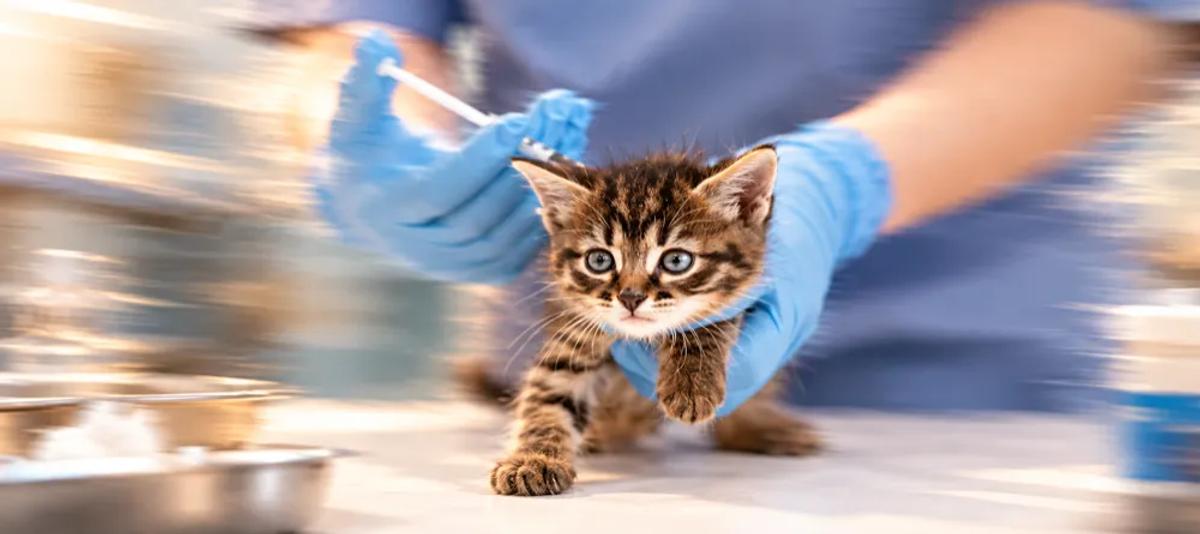
A kitten in India gets its first FVRCP vaccine at six to eight weeks, then a further dose every three to four weeks until it is at least sixteen weeks old, then one more at twenty-six weeks or older, with the first rabies shot from three months of age. Miss the timing and a kitten sits unprotected through the exact weeks it is most fragile.
The kitten months are the part of the cat vaccination guide with the most moving parts, so here they are week by week.
Start with the kitten's history
Before any schedule, find out what your kitten has already had. A kitten from a breeder or a good shelter usually comes with a vaccination card. One picked up off the street or handed over informally often comes with nothing. Either is fine to work with. Take the card, or the honest answer that there is none, to your first vet visit, and let the vet set the starting point from the kitten's age and history. If the record is missing or unclear, a vet will begin a sensible course rather than gamble on shots that may already have been given. That first visit doubles as a general health check and the moment to sort out worms and a feeding plan, so it earns its place even before the needles start.
Why a kitten needs a whole series
A kitten borrows immunity from its mother by drinking colostrum, the first milk, in the hours right after birth. After the first day or two the gut stops absorbing those antibodies, so what the kitten took in then is all it ever gets. That borrowed protection is real, and it is also the problem. It fades over the first months, and while it is still present it can block a vaccine from taking properly. No one can say for a given kitten exactly when it fades. So instead of guessing, vets give a series of shots a few weeks apart, which covers the kitten whenever the gap opens.
The WSAVA framework puts it plainly: the most important dose is the one at sixteen weeks or older, because by then the borrowed immunity has usually gone and the vaccine can do its work. But usually is not always. That is why the WSAVA schedule carries a further dose at twenty-six weeks or older, to catch the minority of kittens still carrying interfering antibody at sixteen weeks. A kitten that gets one early shot and nothing after still has almost no real protection.
The week-by-week series
Following the WSAVA schedule, a typical kitten course looks like this. Read each line as the age, then the vaccine, then what that dose is doing:
- 6 to 8 weeks: first FVRCP. The core shot against panleukopenia, feline herpesvirus and calicivirus, and the opening of the series.
- 9 to 12 weeks: second FVRCP. Given three to four weeks after the first, to catch the kitten if the mother's immunity has faded by then.
- From three months of age: first rabies shot. MSD Animal Health India's Nobivac Rabies, which is indicated for dogs and cats alike, gives the primary dose after three months of age, and allows an earlier one only if a repeat follows at three or six months. Your vet works to the leaflet of the vaccine actually in the fridge, and leaflets differ between products.
- 16 weeks or older: the last FVRCP of the kitten series. The dose that matters most, because borrowed immunity has usually gone by this point.
- 26 weeks or older: one further FVRCP. WSAVA moved this dose here in its 2016 guidelines, in place of waiting until twelve to sixteen months, so that a kitten whose sixteen-week shot was blocked is covered without months of delay. AAHA and AAFP adopted the same six-month dose for cats in 2020, and WSAVA's 2024 revision tightened the timing to at or shortly after twenty-six weeks. The adult schedule runs on from there.
The exact dates shift with your kitten's age when you start and your vet's read on its risk. A kitten in a high-risk setting, like a shelter or a home with other cats coming and going, may be kept on shots a little longer. What stays fixed is the shape: you start early, repeat every three to four weeks, land the last of the series no earlier than sixteen weeks, and come back once more at twenty-six weeks or later. That is why the dose count varies. A kitten starting at six weeks usually needs four FVRCP doses to reach sixteen weeks on a three-to-four-week gap, while one starting at nine or ten weeks may need only three, and the twenty-six-week dose sits on top of either count. If the letters on the card are the confusing part, the FVRCP explainer breaks down what each one covers, and the rabies guide for cats has the adult interval and the legal position for once the kitten course is behind you.
You may read that a kitten should also have the FeLV vaccine, since WSAVA treats it as core for cats under a year old in places where feline leukaemia virus is a concern. That advice is hard to act on here, because no FeLV vaccine appears anywhere on India's published register of veterinary vaccines. Testing is the lever you do have. Ask your vet about an FeLV test for the kitten and for any cats it is joining, and before you bring home a cat of unknown status.
When is a kitten actually protected
A kitten is not covered the day it gets its first shot. Protection builds over the series and is at its most reliable once the sixteen-week dose has had time to take. Even then it is not absolute. AAHA and AAFP report that up to a third of kittens may fail to respond to a core vaccine at sixteen weeks and may still have blocking maternal antibody at twenty weeks, which is exactly what the twenty-six-week dose is there for. WSAVA's guidance for cats heading into a boarding cattery is to vaccinate one to two weeks before the exposure, which is a fair guide to how long a single shot needs.
Until then, keep a kitten in, away from strange cats and from places where cats gather. It is tempting to show a new kitten the world, and the world is exactly where panleukopenia and cat flu are waiting. Once the sixteen-week dose has had a week or two to take and your vet gives the go-ahead, a kitten can start meeting the outside on your terms. The twenty-six-week dose is not a gate you wait behind, it is a top-up that comes later.
Deworming usually comes along for the ride
Deworming and vaccination are two different jobs, and they often share a visit for the simple reason that the kitten is already in the clinic. This guide puts no schedule on deworming, because the interval depends on the kitten and on what your vet finds. Raise it at the first visit and let it ride along with the vaccine appointments.
Frequently asked questions
At what age should a kitten get its first vaccine?
Six to eight weeks for the first FVRCP. Rabies comes a little later, from three months of age. Earlier than six weeks is not where the guidelines start the series, partly because the mother's borrowed immunity is usually still high enough to block the vaccine and partly because the vaccine datasheets do not cover it. There is a hard floor underneath that: WSAVA says live vaccines should not be given to a kitten under four weeks old at all.
How many vaccinations does a kitten need?
Usually three to four FVRCP doses across the first four months, spaced three to four weeks apart, with the last of them at sixteen weeks or older, then one further dose at twenty-six weeks or older. Add the first rabies shot from three months of age. No FeLV product appears on India's published register of veterinary vaccines, so ask your vet what is actually stocked locally before planning an FeLV dose into the series. Your vet sets the exact count from your kitten's start age.
Do indoor kittens need the full course?
Yes. The viruses behind panleukopenia and cat flu hitch a ride indoors on footwear and on other animals, and an indoor kitten still needs rabies cover in an endemic country. Indoor life lowers some risks, but the core series is still needed.
My kitten missed a dose. Do we start over?
Usually not. In most cases the vet gives the next dose and carries on, though a very long gap can mean an extra shot. Ask your vet before the gap grows any longer.
The bottom line
A kitten's FVRCP starts at six to eight weeks and repeats every three to four weeks, with the last of the series at sixteen weeks or later, one more dose at twenty-six weeks or older, and rabies from three months of age. Keep the kitten in until the sixteen-week dose has taken. For the full adult picture and what the law says about rabies, see the main cat vaccination guide.
Nuzzy's PetLife can hold the kitten schedule and nudge you before each dose is due, which is the easiest way to make sure the sixteen-week and twenty-six-week shots actually happen on time.
Sources
- 2024 guidelines for the vaccination of dogs and cats. Squires RA, Crawford C, Marcondes M, Whitley N, for the WSAVA Vaccination Guidelines Group. Journal of Small Animal Practice 2024;65:277-316. doi:10.1111/jsap.13718 (the kitten core series at 6 to 8 weeks, repeated every 2 to 4 weeks until 16 weeks of age or older, with a further dose at 26 weeks of age or older to reach the minority of kittens still carrying interfering maternal antibody; maternal antibody acquired from colostrum in the hours after birth; live attenuated vaccines not to be given to kittens under 4 weeks of age; revaccination 1 to 2 weeks before a boarding cattery; FeLV core for cats under a year old where FeLV is prevalent, and only after a negative test).
- 2020 AAHA/AAFP Feline Vaccination Guidelines. Stone AES, Brummet GO, Carozza EM, Kass PH, Petersen EP, Sykes J, Westman ME. Journal of the American Animal Hospital Association 2020;56:249-265. doi:10.5326/JAAHA-MS-7123 (up to one-third of kittens may fail to respond to a final core vaccine at 16 weeks and may have blocking maternal antibody at 20 weeks, which is why the AAHA/AAFP Task Force adopted WSAVA's recommendation and replaced the 1-year dose with revaccination at 6 months of age; also the expansion of FVRCP, which this document spells out in its own text as feline viral rhinotracheitis-calicivirus-panleukopenia).
- Recommendations on vaccination for Asian small animal practitioners. Day MJ, Karkare U, Schultz RD, Squires R, Tsujimoto H, for the WSAVA Vaccination Guidelines Group. Journal of Small Animal Practice 2014. doi:10.1111/jsap.12272 (maternal antibody taken in from colostrum only during the first 24 to 48 hours of life). Fieldwork was carried out in 2012 and 2013, and the 2020 in the URL path is the hosting date, not the publication date.
- Veterinary vaccines granted marketing authorisation. Central Drugs Standard Control Organisation, Ministry of Health and Family Welfare, Government of India (the three feline vaccines on this published register, every one of them the panleukopenia-calicivirus-rhinotracheitis combination; no FeLV product anywhere on the register).
- Guideline for feline panleukopenia. European Advisory Board on Cat Diseases (what panleukopenia does to an unprotected kitten, and how long the virus stays infectious in the environment).
- Guideline for feline calicivirus infection. European Advisory Board on Cat Diseases (cat flu, and why it is hardest on kittens).
- Nobivac Rabies. MSD Animal Health India (dog and cat, age at primary vaccination after 3 months of age; first footnote: primary vaccination can be administered at an earlier age, but then a repeat vaccination must be given at the age of 3 or 6 months depending on the species).