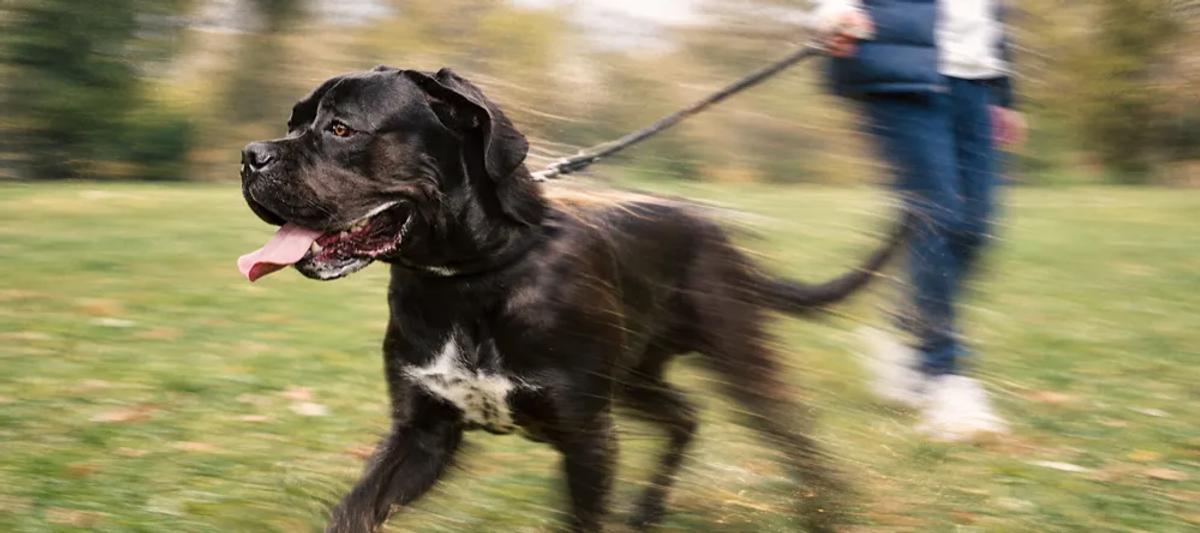
The Cane Corso is described in its breed standard as a sturdy utility dog with a short, dense coat and a guardian role. The standard gives adult weights of 45 to 50 kg for males and 40 to 45 kg for females, alongside height ranges. These describe the breed's intended type; your dog's care still needs an individual plan.
If you are considering a Cane Corso, think through everyday learning, household arrangements and professional support before relying on a guardian description. If you already share your home with one, use those same questions to review the routine. Longevity research is still exploratory, so a confident promise about how long your dog will live deserves scrutiny.
Cane Corso size and physical characteristics
The standard gives heights of 64 to 68 cm for males and 60 to 64 cm for females, with a tolerance of 2 cm above or below the stated range. Male weights are 45 to 50 kg and female weights 40 to 45 kg, with weight considered in relation to size.
Keep the measurements together when comparing descriptions. A height figure on its own leaves out part of the physical picture, while a weight range cannot tell you what your individual dog should weigh. Bring the actual measurements into a veterinary care discussion if you are uncertain about them.
The coat is described as short, shiny and very dense, with a slight undercoat. The standard includes black, several grey and fawn shades, and brindle patterns. It also allows a small white patch in specified areas, including the chest and tips of the toes. Those details concern the standard's appearance criteria.
If you are comparing guardian-breed profiles by adult dimensions, the guide to Doberman size and care provides a second set of attributed measurements. Read the height and weight figures together in both profiles. Then consider the dog you are meeting: its health and observed behaviour still need their own assessment.
Make household fit an individual decision
The standard refers to guardianship of property, family and livestock. It also describes responsiveness and agility. They describe the breed's intended role and qualities. How a particular Cane Corso responds in your home needs a separate assessment.
Veterinary guidance considers behaviour in relation to genetics, experience and environment. Ask what is known about the individual: the situations it has encountered, its responses and any care or behaviour support already provided. Keep unanswered questions visible when you speak to the veterinary team.
Our guide to responsible care for guard dogs can help you structure the household conversation. Decide who will take responsibility for ordinary learning and who will contact the vet if concerns arise. A shared plan is more useful than everyone assuming someone else will handle the difficult parts.
Prepare the surroundings as well. For a young dog, life-stage guidance recommends securing rubbish containers and accessible cupboards, putting away loose personal items and stabilising furniture that could tip. Walk through those tasks before they are needed.
Aggression or severe fear needs veterinary assessment. Ask your vet about appropriate referral options instead of treating every concern as a manners lesson for a trainer.
Build learning around rewards
Start with a behaviour you want the dog to perform. Veterinary behaviour guidance recommends rewarding each occurrence while a new behaviour is being learned, then using intermittent rewards after it has been acquired. The practical discussion with a trainer should explain what you will ask for and how you will respond.
Ask about methods directly. A 2020 study of dogs attending training schools found more stress-related behaviour in the heavily aversive group than in the reward-based group. The dogs were recruited through their existing schools rather than assigned randomly, so the findings show an association and do not establish that training method alone caused the differences.
The veterinary guidance also recommends rewarding desired behaviour and opposes aversive methods. You don't need to turn a Cane Corso's guardian description into a reason for harsher teaching. Ask the trainer to explain how the dog will learn the everyday behaviour you're requesting.
For a puppy, new experiences should be positive and guided by its response. More exposure is not automatically better when the puppy is struggling. Ask your vet for help with situations that are difficult, instead of expecting the problem to disappear as the puppy grows.
Punishment is especially concerning when aggression is involved. Guidance warns that it can increase bite risk and aggravate aggressive behaviour. Bring those concerns to the veterinary team rather than escalating the encounter.
Plan activity and enrichment
Discuss physical activity and cognitive engagement when reviewing your dog's routine. Veterinary guidance recommends planning both around the individual, with realistic expectations about behaviour. A breed description cannot set a universal number of daily kilometres or hours.
Explain the activities you can provide and the practical limits of your day. That gives your vet something specific to discuss in relation to the dog's life stage and health. Include ordinary learning in the conversation instead of measuring the whole routine by time spent moving.
Enrichment changes what is available for the dog to do in its environment. A food toy is one example in behaviour guidance, but the same guidance notes that some distressed dogs need more help than enrichment alone can offer. Discuss what you hope the activity will help with and watch how your dog responds.
If a concern persists, describe it to your vet. Explain which activities you've tried and how the dog responded, so the team can consider whether further assessment is appropriate. A working background gives you context, but each concern still needs attention.

Read longevity research cautiously
A 2022 genetic study investigated possible associations with longevity in Cane Corso dogs. After an initial genetic comparison, the researchers examined selected variants in samples from 20 long-lived dogs and 20 reference dogs, including dogs from that first comparison.
The study reported gene associations worth investigating, but the initial comparison was small and none of its variants reached the genome-wide significance threshold. The authors said their findings needed confirmation in a longitudinal study of more dogs before the variants could be used as breeding markers.
The findings are an early research result. There is more work to do before these variants can inform breeding decisions, and this study does not establish a validated test for predicting an individual dog's lifespan.
For care decisions now, bring your dog's actual history and questions to the veterinary team. Keep the study's limitations in mind if someone cites it while promising that a particular Cane Corso will live longer.
Frequently asked questions
How large does a Cane Corso grow?
The standard describes males at 64 to 68 cm and females at 60 to 64 cm, with a 2 cm height tolerance. It lists weights of 45 to 50 kg for males and 40 to 45 kg for females in relation to size. These are standard descriptions rather than individual health targets.
What can research tell us about Cane Corso lifespan?
The 2022 genetic study reported exploratory associations in a small sample, with further confirmation needed. It does not provide a validated prediction for the lifespan of an individual dog. Keep that uncertainty attached to any summary of the findings.
Find support for your care plan
Choose the question you need help with before looking for a service. It might concern ordinary learning, an observed behaviour or veterinary care. PetMap supports place discovery, including veterinary services, so you can explore options and contact them to discuss your needs. Confirm the service offered directly rather than assuming a listing answers every care question.
Sources
- FCI Cane Corso standard 343, valid standard 25 September 2023
- AAHA 2015 canine and feline behavior management guidelines
- AAHA 2019 canine life stage guidelines, Behavior
- Korec et al., Four novel genes associated with longevity found in Cane corso purebred dogs, BMC Veterinary Research, 2022
- Vieira de Castro et al. Does training method matter? Evidence for the negative impact of aversive-based methods on companion dog welfare. PLOS ONE, 2020.
- Creevy et al. 2019 AAHA Canine Life Stage Guidelines.