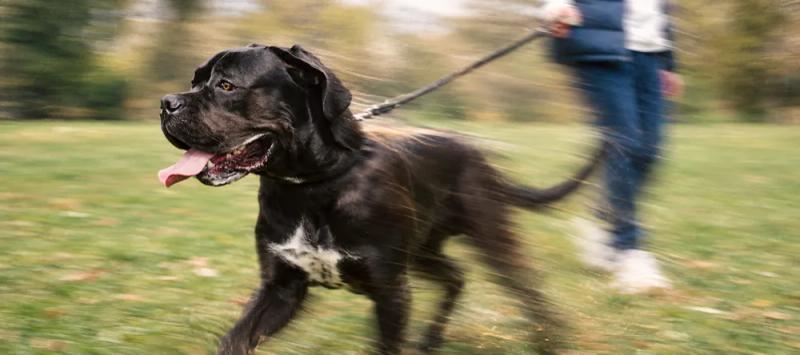
The Doberman is described in its breed standard as a short-coated companion, protection and working dog. Black or brown coats with rust-red markings are part of that description, along with a calm, family-devoted temperament as the ideal. Your own dog's behaviour and care needs still depend on individual experience, surroundings and health.
Plan how you will teach everyday behaviour and discuss suitable activity with your vet. Heart health belongs in that conversation too, because early heart disease may have no obvious signs. An alert-looking Doberman can still need an assessment; appearance alone gives you an incomplete picture.
Doberman size and coat
The standard uses the spelling Dobermann. It gives adult heights of 68 to 72 cm for males and 63 to 68 cm for females, measured at the withers. Approximate weights are 40 to 45 kg for males and 32 to 35 kg for females. These are reference descriptions from the standard, rather than a prescribed weight for every dog.
When recording your dog's weight, keep the actual measurement and the vet's assessment together. The number in a breed description cannot decide whether an individual should gain or lose weight. That decision belongs in the broader examination and care discussion.
The coat is described as short, hard and dense, lying close and smooth against the body. The two stated colours are black and brown, both with clearly defined rust-red markings. The standard describes markings on several areas, including the muzzle, eyebrows, chest and legs.
Those markings are useful when reading a breed description or comparing photographs. They tell you about appearance. For decisions about living with a particular Doberman, ask separately about its care history and behaviour around unfamiliar people.
Temperament and life in your household
The temperament described in the standard is an ideal: friendly and calm, devoted to family, attentive and willing to work. Read those words as a description of the intended breed type. They cannot guarantee that any particular Doberman will be easy to train or comfortable in every family situation.
Veterinary guidance considers behaviour in relation to genetics, experience, developmental stage and environment. That gives you a more useful starting point when deciding how a dog might fit into your home. Ask what the dog has experienced and what people have actually observed, rather than relying on a reassuring adjective.
For a household comparison, our guide to responsible care for guard dogs puts those questions alongside the shared care responsibilities. Work through who will manage learning and veterinary visits, and which uncertainties still need a professional discussion.
You can be interested in the breed and cautious about an individual situation at the same time. Missing information about a dog's responses should remain a question to investigate.
Teach useful everyday behaviour
Reward the behaviour you want. Veterinary behaviour guidance recommends rewarding a new behaviour each time it occurs during learning, then using intermittent rewards after it has been acquired. This gives your training conversation a clear focus: what the dog is being asked to do and how that response will be reinforced.
Ask a trainer to explain the method in those terms. Ask how everyday manners will be taught and what happens when the dog finds a request difficult. The answer should describe something you can practise at home.
For a puppy, pay attention to the response during new experiences. Positive exposure involves more than meeting a set number of people or visiting a long list of places. Guidance warns that exposure without evaluating the puppy's response can increase problem behaviour rather than help the puppy become comfortable.
If fear or aggression is part of the picture, avoid treating punishment as the next training step. Veterinary guidance warns that punishment in aggression cases can aggravate the behaviour and increase bite risk. Describe the concern to your vet and ask what assessment or referral is appropriate.
Keep the learning task clear. If an encounter becomes difficult, describe what happened so the trainer or veterinary team can help you decide how to proceed.
Plan activity around the individual dog
Discuss physical activity and cognitive engagement as separate parts of the routine. Veterinary guidance recommends considering individual exercise needs and suitable opportunities to use the brain. A working-dog description does not translate into one daily distance or number of hours for every Doberman.
Explain the routine you can offer, including the time available for learning and the activities you are considering. Ask your vet how the plan fits the dog's life stage and health findings. Our guide to planning your dog's exercise develops the individual-planning approach without treating one breed label as a complete programme.
Enrichment can give a dog something appropriate to do in its surroundings. Food toys are one example discussed in behaviour guidance. However, a dog with a behaviour problem may be too distressed for enrichment alone to make a difference.
If behaviour remains difficult to understand or manage, tell your vet what you've tried and how the dog responded. That gives the team a concrete starting point when considering whether further assessment is needed.

Discuss heart health with your vet
Dobermans can have heart abnormalities before obvious illness is apparent. In a 2025 study of European Dobermans, researchers included apparently healthy dogs and dogs with preclinical dilated cardiomyopathy, commonly shortened to DCM. Participating dogs underwent heart imaging and electrical rhythm examinations as part of the research.
This was a selected research sample. It does not provide an estimate of DCM prevalence in Indian Dobermans, and its research procedures are not a screening schedule for your dog. The useful care question is what assessment your vet recommends for the individual.
Veterinary information about DCM explains that early disease may have no obvious signs. An echocardiogram assesses heart size and pumping function. An electrocardiogram, or ECG, records electrical activity to check the rhythm. A Holter monitor records the ECG over a longer period, allowing the veterinary team to assess rhythm changes across the day.
Ask which tests are appropriate and what the results would help the vet decide, so you understand the role of each examination in the care plan. Bring existing reports to that conversation so the team can consider what has already been checked.
The 2025 paper also investigated a specialised recording method. That research should not be turned into a recommendation that pet parents seek the experimental method in routine practice. Keep the conversation centred on the clinical options your veterinary team considers appropriate.
Frequently asked questions
What is a Doberman's temperament like?
The breed standard describes a friendly, calm and family-devoted ideal, with willingness to work. An individual dog's behaviour also reflects its experience and environment. Assess the dog itself and discuss concerns instead of treating the standard as a guarantee.
Which coat colours are in the Dobermann standard?
The standard describes black and brown coats with clearly defined rust-red markings. It describes a short, hard and dense coat lying close to the body. These are appearance criteria, so they do not replace a health or behaviour assessment.
Keep care information together
Keep your dog's actual weight records and veterinary visit history in one place. PetLife supports both, so you can organise the information alongside the questions you want to raise at the next appointment. Add the veterinary team's findings to your records rather than trying to interpret a breed description as a personal care target.
Sources
- FCI Dobermann standard 143
- AAHA 2015 canine and feline behavior management guidelines
- AAHA 2019 canine life stage guidelines, Behavior
- Cornell Riney dilated cardiomyopathy
- Gheeraert et al. Septal-to-basal ventricular peak activation time determined by vectorcardiography as a potential new pre-screening parameter for preclinical dilated cardiomyopathy in Doberman Pinschers. Frontiers in Veterinary Science, 2025.
- Creevy et al. 2019 AAHA Canine Life Stage Guidelines.