The Boxer dog is described in its breed standard as a compact, square-built companion, guard and working dog with a short coat. Fawn and brindle are the stated colours. Its playful, watchful temperament is part of the breed ideal, while the care of an individual Boxer depends on its experience, behaviour and health.
Start with the dog you are caring for. Teach everyday behaviour through rewards, discuss suitable activity with your vet and keep care observations specific. A UK study of Boxers offers useful breed-level context, including recorded ear, mouth and eye conditions, but it cannot tell you which condition your own dog has.
Boxer build, coat and adult weight
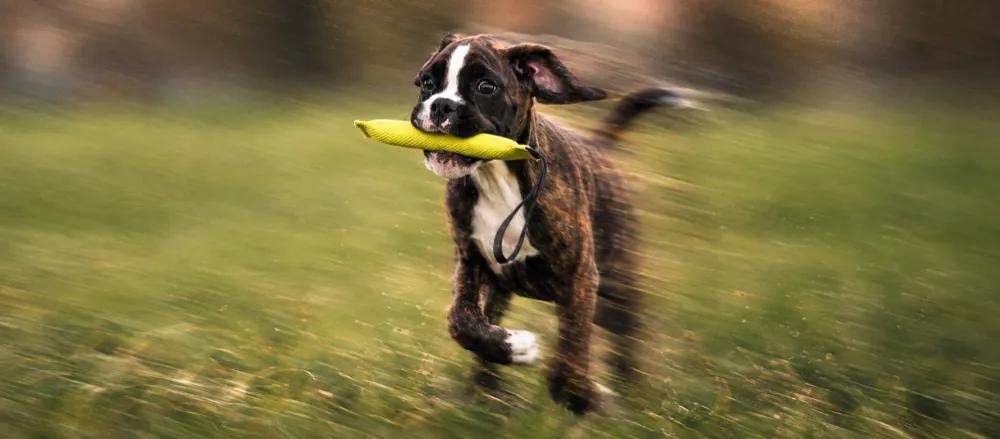
The standard describes a sturdy dog with a compact, square build and a short, close-fitting coat. Fawn can vary in shade, while brindle describes darker stripes against a fawn background. The description also includes a black mask and allows white markings.
Adult height ranges are 57 to 63 cm for males and 53 to 59 cm for females. The weight wording needs closer attention: it describes males over 30 kg at a height of about 60 cm and females around 25 kg at about 56 cm. Those height qualifications belong with the numbers.
Keep the height and weight figures together when comparing adult size. The standard describes the breed's proportions. Your vet can assess what your own Boxer should weigh using the actual measurements and examination findings.
Coat appearance also has a limited role in care decisions. A photograph can show markings, but it leaves questions about the dog's health and behaviour unanswered. If you're considering a Boxer, ask for its care history alongside the description of its appearance.
Understand temperament without guarantees
The Boxer standard describes calmness, confidence, watchfulness and friendliness in play as desirable qualities. That is the intended temperament in the standard. It should not become a promise that every Boxer will be comfortable with every person or situation.
Veterinary behaviour guidance considers genetics alongside experience and surroundings. Ask about the dog's actual responses when you are planning care: what has been observed, which situations are familiar and where help has already been needed. A description such as playful leaves those questions unanswered.
Our guide to responsible care for guard dogs places the Boxer alongside other breeds with working or guardian descriptions. It focuses on the household responsibilities behind those labels.
Use that broader discussion to decide who will handle daily learning and veterinary conversations. You can then bring specific concerns to the appropriate professional rather than expecting the breed's reputation to settle them. The individual dog's history deserves room in the decision.
Use reward-based training in daily life
Choose the behaviour you want to teach and make the reward clear. Veterinary guidance recommends rewarding a new behaviour each time it occurs while it is being learned. Once it has been acquired, rewards can become intermittent. Discuss how to apply this with your trainer, including how you will recognise the behaviour you intend to reward.
Ask how the trainer handles a dog that is struggling with a request. The explanation should help you understand what you will do at home, including how desired responses are encouraged. Teaching ordinary manners is a specific task; it does not require a promise about developing guard behaviour.
For puppies, evaluate the response to new experiences. Simply increasing the number of encounters does not establish that those encounters are positive. Veterinary guidance warns that exposure without attention to the puppy's response can increase problem behaviour.
Fear or aggression calls for a different conversation. Punishment can worsen aggression and raise bite risk, according to behaviour guidance. Bring the concern to your vet and ask about assessment, instead of treating a more forceful training method as the automatic answer. Be precise about what happened and what seemed to prompt it.
Fit activity and surroundings to your dog
Plan exercise around the individual. Veterinary guidance recommends discussing activity needs and suitable cognitive engagement, taking the particular dog into account. The Boxer standard's lively description cannot tell you how long every Boxer should exercise each day.
Explain the routine you have in mind when you speak to your vet. Include opportunities for learning as well as physical activity. If you are adding enrichment, keep its purpose realistic. Behaviour guidance describes food toys as one option, while noting that a distressed dog may need more help than enrichment alone can provide.
For a young dog, review the home environment too. Put away clothes, shoes and loose toys, secure accessible rubbish containers and cupboards, and stabilise furniture or objects that could fall. These are ordinary preparations from life-stage care guidance.
Share the plan with everyone involved in care. The useful question is whether responsibilities are clear and the arrangements fit this dog. Write down what each person has agreed to do so you can discuss the proposed routine together.
What a UK Boxer study tells pet parents
A study published in 2023 examined the veterinary records of Boxers in UK primary care during 2016. The population included 3,219 Boxers within a wider dataset of dogs. Its findings describe recorded conditions in that setting and year, rather than present-day disease rates for Boxers in India.
The most frequently recorded individual disorders included otitis externa, epulis, corneal ulceration and periodontal disease. Keep those findings as topics for a veterinary conversation. They are not a checklist for diagnosing your dog at home.
If you want to understand the ear topic further, our guide to ear infections in dogs explains the assessment discussion. The guide to dog dental care develops the separate mouth-care topic. Use them to prepare questions if either subject comes up during an appointment.
The study also compared white and non-white Boxers. It found limited evidence of substantial overall health differences, but the results were not identical for every recorded outcome. White Boxers had a higher recorded prevalence in two broad disorder groups, dental and brain disorders. Those differences are part of the findings too. The study does not establish that all colour-associated risks are equal or absent.
For your own Boxer, take observations and previous findings to the vet. A physical examination considers individual health, including pain and movement, while the records help keep care information together. Research can inform the questions. It cannot supply the examination result.
Frequently asked questions
What is a Boxer dog's temperament like?
The breed standard describes a calm, watchful dog that is friendly in play. Those qualities are the standard's ideal, and an individual Boxer also reflects its experience and environment. Discuss observed behaviour when assessing how a Boxer might fit into your household.
What adult weight does the Boxer standard describe?
It describes males over 30 kg at about 60 cm tall and females around 25 kg at about 56 cm. The height qualifications are part of the description. Your vet's assessment is the basis for discussing an individual dog's weight, rather than treating these figures as feeding targets.
Prepare for the next vet conversation
Keep the questions raised by your Boxer's actual care separate from general breed information. PetLife supports weight logs and vet visit history, so you can keep those records together between appointments. Bring the observations you want to discuss and ask the veterinary team to explain how their findings shape the next step.
Sources
- FCI Boxer standard 144
- AAHA 2015 canine and feline behavior management guidelines
- AAHA 2019 canine life stage guidelines, Behavior
- O’Neill et al. Demography, common disorders and mortality of Boxer dogs under primary veterinary care in the UK. Canine Medicine and Genetics, 2023;10:6.
- Creevy et al. 2019 AAHA Canine Life Stage Guidelines.