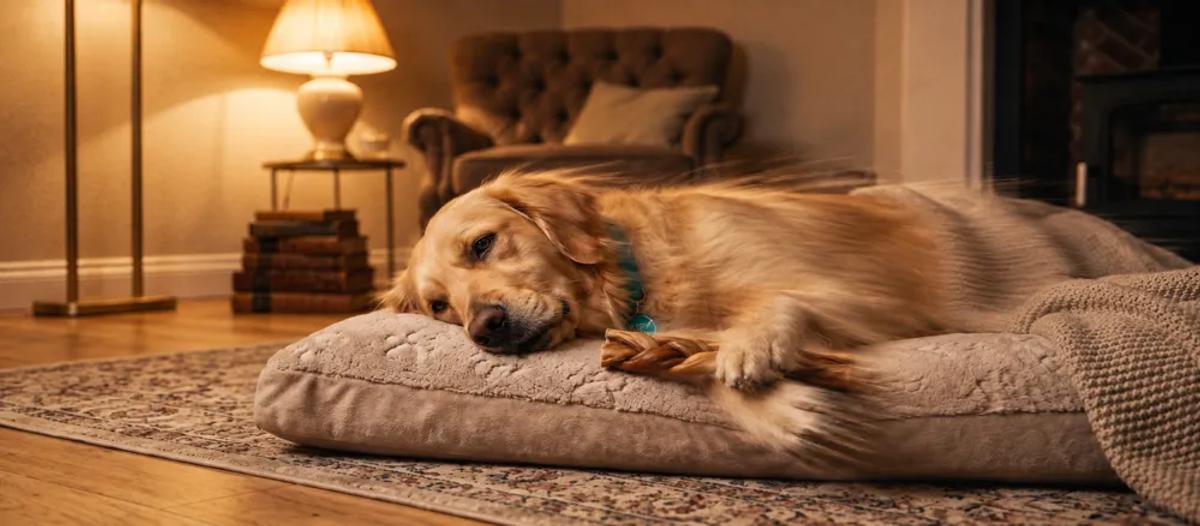
Dog sleep varies, and research does not establish one daily number that every dog needs to reach. A dog lying on its bed may be resting without being asleep, which makes even a careful estimate uncertain. Start with what you can observe in your own home.
You can note where your dog sleeps and the naps you see, while leaving gaps for periods when nobody is watching. That gives your household a place to start discussing its routine. It doesn't turn an estimate into a medical assessment, or make a missed afternoon observation a problem to solve.
How much sleep does your dog need?
A 2020 study followed reports from pet parents in the United Kingdom and Republic of Ireland at two points in their dogs' lives: 16 weeks and 12 months. The younger puppies were reported to sleep more during the day and across a full day, but less during the night. Age changed the pattern as well as the total.
Those results describe the dogs in that study. They don't give a prescribed allowance for your puppy, and the two ages cannot supply a week-by-week chart for everything in between. If you're planning a puppy sleep routine, leave room for that uncertainty instead of choosing clock times from a chart that the research never tested.
A separate 2022 survey collected caregiver reports for 1,330 dogs. It found relationships between reported sleep and reported behaviour problems, but could not determine an optimal sleep duration. A relationship in a questionnaire cannot tell us that changing the number of hours will fix a particular behaviour.
There is a practical measurement problem here too. If you sleep in a different room, you may not know when your dog wakes. During the day, lying quietly can look like sleep. Pet parents' accounts are useful observations, but treating them as continuous sleep recordings gives the numbers more precision than they have. Leave gaps when you're unsure.
Make room for daytime rest
Adding activity whenever a dog has a behaviour problem can interfere with the rest already happening. The authors of the 2022 survey caution against increasing activity when that deprives a dog of sleep. Their findings support taking rest seriously when discussing behaviour; they do not establish an exercise programme or a guaranteed sleep-based treatment.
For your household, look at how the day is arranged before adding another activity purely to keep your dog awake. As a planning exercise, write down the naps someone actually notices and who is at home during those periods. Leave the duration blank when you don't know it. There is no need to turn each quiet spell into a target your dog must meet.
If several people share care, you can put the chosen arrangement in a household WhatsApp message. Include the sleeping place and who is supervising when a puppy needs supervision. Keep observations separate from decisions: a nap you saw is an observation, while the place you've agreed to offer is a household choice.
Choose a sleeping arrangement
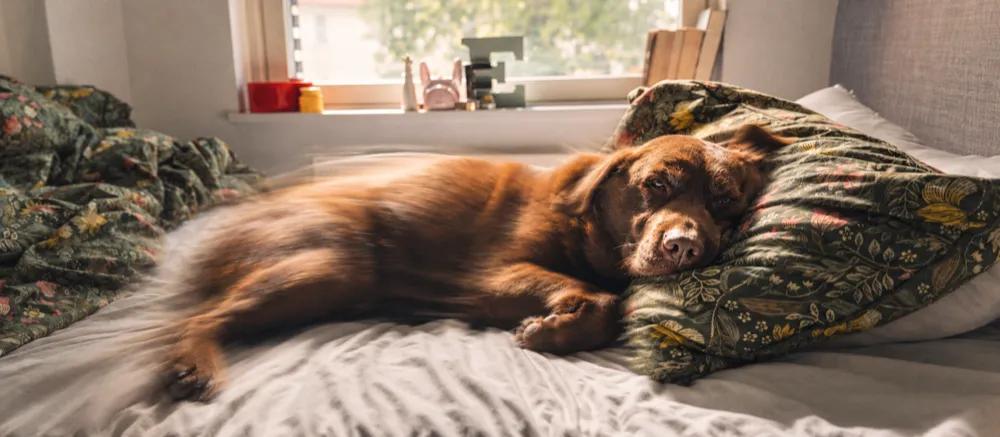
Choose an arrangement you can explain consistently to everyone involved. Some pet parents allow their dog on the bed, some allow access by invitation, and others choose a separate sleeping place. Studies also report that dogs given access sometimes choose to sleep near people, but that observation does not make bed-sharing a requirement.
Be specific about what you have decided. “On the bed by invitation” means something different from unrestricted access, so agree which arrangement you intend to follow. It cannot promise that every dog will settle immediately, and a description of common sleeping arrangements does not establish that every arrangement is safe for every household.
For a puppy you cannot supervise, the practical guidance is to provide a safe crate or pen. It does not specify how many hours a puppy should spend enclosed, require confinement for every nap, or provide a sleep-training programme.
Sleeping positions and movements
Sleeping on the side, curled up, on the back and with the head propped up were all reported in the young-dog study. Pet parents could choose several positions when answering. A single dog could therefore appear in more than one category; the categories were never a set of personality types.
Our guide to dog sleeping positions explains these observations and their limits. A pose cannot tell you that your dog trusts you more, feels a particular emotion or has a specific illness. Research on sleep-related breathing found some unusual positions in dogs with breathing problems, but also recorded them in dogs without the same measured problem.
Small leg movements during sleep were also reported by pet parents. A later survey described similar observed sleep behaviours associated with REM sleep. Neither questionnaire could establish what a dog was dreaming about. A paw moving across a bed does not reveal a dream about chasing something, however easy that story is to picture.
If your concern is twitching during sleep, the next question is whether the event needs veterinary assessment. Familiar-looking movement does not rule out a seizure. Contact a vet promptly about an ongoing suspected seizure; the emergency guidance below explains why waiting for a time threshold is unsafe.
Snoring and disturbed nights
Short-muzzled dogs can have upper-airway abnormalities that obstruct airflow. Studies of sleep-related breathing found an association with this skull shape, but the amount of snoring did not reliably indicate severity within the short-muzzled group. A familiar noise still needs to be considered in context. The article on snoring during sleep explains what a vet may assess.
Nighttime changes in an older dog deserve their own description. Veterinary guidance on ageing dogs discusses roaming around the home at night and altered routines. Waking at night alone does not establish dementia. Keep the description to what you notice, rather than assigning a condition from one behaviour.
You may be dealing with a dog that is awake and vocalising instead of one making sounds while asleep. For that separate concern, see howling while awake at night. When you describe the night, say whether you actually saw your dog awake. If you only heard a sound from another room, leave that distinction open.
When to get veterinary help
Breathing difficulty needs immediate veterinary care. Blue gums, pronounced effort from the abdomen while breathing, or weakness or collapse are concerning signs. Any sign of respiratory distress warrants urgent attention; your dog does not need to show the entire list before you act. Take your dog to the nearest emergency veterinary service.
Contact a vet promptly about an ongoing suspected seizure. Veterinary seizure guidance uses five minutes as an emergency threshold by which treatment should already have started. Do not wait five minutes to make contact. Repeated seizures without recovery of consciousness between them are also an emergency, as are multiple seizures within 24 hours under the practical emergency advice for pet parents.
The action matters more than choosing a diagnostic label yourself. Tell the clinic what is happening and whether the event is continuing, so the conversation stays focused on getting care. A sleeping-position change, a quieter room or a plan for tomorrow cannot substitute for immediate attention when breathing is difficult or seizures are prolonged or repeated.
Plan for nights away from home
For a planned boarding stay, include the sleeping arrangement in your handover. Explain where your dog usually sleeps and which parts of the arrangement are household choices. You can also describe the naps or night waking you have actually observed, without presenting estimates as a fixed requirement the boarder must reproduce.
The guide to preparing for dog boarding covers the sleeping-space and overnight-care discussion. PetMap can help you shortlist boarding places. Speak to the place directly about the arrangement you want before deciding on a stay.
Frequently asked questions
How much do dogs sleep?
Sleep varies, and caregiver surveys cannot establish a required daily total for every dog. Quiet rest can be mistaken for sleep, while periods outside your view remain uncertain. There is no universal hour target established by these studies.
How does a dog's sleep change with age?
In a UK and Republic of Ireland cohort, 16-week-old puppies were reported to sleep more during the day and overall, but less at night, than 12-month-old dogs. That comparison does not provide required hours for every age.
Sources
- Kinsman et al. (2020), Animals: Sleep duration and behaviours in dogs up to 12 months of age
- Tooley and Heath (2022), Animals: Sleep characteristics in dogs; effect on caregiver-reported problem behaviours
- Tufts Cummings School (2021): Sleeping with dogs
- Niinikoski et al. (2024), Journal of Veterinary Internal Medicine: Risk factors for sleep-disordered breathing in dogs
- Charalambous et al. (2023), Journal of Veterinary Internal Medicine: ACVIM consensus statement on status epilepticus and cluster seizures in dogs and cats
- Cornell Riney Canine Health Center: Idiopathic epilepsy in dogs
- Niinikoski et al. (2023), Journal of Veterinary Internal Medicine: Description of a novel method for detection of sleep-disordered breathing in brachycephalic dogs
- Cornell Riney Canine Health Center: Brachycephalic obstructive airway syndrome
- Cornell Riney Canine Health Center: Senior dog dementia
- Cornell Riney Canine Health Center (updated March 2025): Recognizing and responding to canine respiratory distress