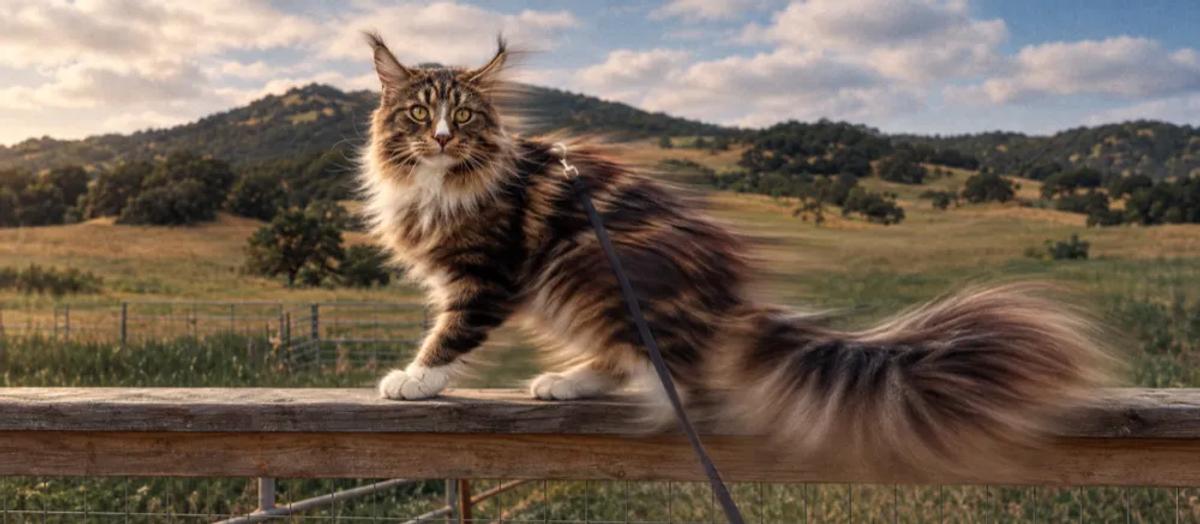
The Maine Coon is described in its breed profile as a large cat, with a coat that is shorter at the shoulders and longer along the sides, stomach and back legs. A long, plumed tail completes that physical description. For a pet parent, the useful questions concern coat care, the individual cat’s feeding plan and the health information that comes with them.
Understand size without chasing a number
Large is a physical description, not a feeding goal. Veterinary nutrition guidance bases a feeding plan on age, reproductive status, activity, health, and body and muscle condition. The assessment concerns the individual cat.
Ask the vet how they assess your cat’s condition and which information they need about the current food routine. Our guide to planning your cat’s daily food amount gives that conversation more space.
Ragdolls also have a large physical profile. Their description includes a broad chest and a muscular body, but those descriptions do not establish that every individual of one breed will be larger than every individual of the other. The Ragdoll size and care profile covers that breed separately.
If you are still choosing, compare cat breeds and care needs alongside your household routine. Consider the individual’s age and personality, the pets already at home and the care responsibilities you can take on.
Before changing food, find out what the cat already eats. A nutritionally complete food should suit its life stage, and a switch should be gradual rather than an abrupt replacement. Bring the current diet details to the feeding discussion.
Care for the coat
The adult Maine Coon’s coat has an uneven outline: shorter over the shoulders, longer down the sides and underneath, with longer hair on the back legs and a plumed tail.
Regular brushing or combing helps keep a cat’s coat clean and gives you a chance to observe the skin for parasites or signs of disease. Discuss the individual coat with the person currently caring for the cat, and ask which parts of the existing routine you will be continuing.
Handling matters during grooming. Respect signals that the cat needs a break. Ignoring those signals can increase fear. If you are unsure what you are seeing, ask for help.
The guide to grooming a cat covers practical care in more detail. Decide who in your household will do the routine work and what help they need.
Brushing removes loose fur before the cat swallows it during self-grooming. Teaching a young cat to accept brushing can make care easier, but handling still needs to follow the individual’s response. Cowering, muscular tension, freezing or trying to leave can indicate distress. Pause when a break is needed rather than assuming that a still cat is comfortable. Ask for a demonstration if you cannot tell whether the cat is relaxed.
Prepare the home around the individual
General feline guidance recommends thoughtfully distributed resting areas, feeding stations, water sources, scratching posts and litter boxes, together with places to hide. Look at where those resources will go in your actual home.
Walk through the plan before bringing the cat home. Identify where they can rest, where the litter box will be and who will look after the everyday care. If other pets already live with you, include that fact in the discussion about whether this particular cat is a good fit.
Choose scratching equipment by observing how the cat scratches. Some cats use vertical surfaces, while others favour horizontal ones. The material matters too. Ask the current carer which surfaces and directions this cat chooses, then use that information when planning a post or pad. A breed’s large build does not tell you its scratching preference.
Check access to the litter box rather than only its location. Kittens and elderly cats with arthritis may need lower sides to get in easily. Keep food and water away from the litter area and maintain clean dishes and fresh contents.
Discuss heart-health records with your vet
Heart-health information about Maine Coons often involves hypertrophic cardiomyopathy, abbreviated HCM. A corrected 2024 genetic study discusses particular HCM-associated variants in Maine Coons and Ragdolls. Its findings require breed-specific interpretation; they do not turn a general breed profile into a diagnosis for the cat in front of you.
Genetic screening can provide information about increased risk. Veterinary guidance also stresses that not every cat carrying the relevant mutations develops HCM. If you receive a report, ask your vet to interpret the actual result and explain what it does and does not establish.
Diagnosis involves echocardiography, which uses sound waves to produce an image of the heart. A vet must also consider other causes of similar heart thickening, including high blood pressure and hyperthyroidism. A genetic result and an examination of the heart address different parts of the assessment.
The correction associated with the genetic paper warns against using one numerical heart-wall thickness to distinguish healthy from affected cats in every case. This is another reason to have the report interpreted clinically rather than comparing a measurement with a number found online.
When you speak with the clinic, ask whether a document describes a genetic finding or a clinical diagnosis. You can ask what the finding means for this cat and whether any follow-up has been advised.
For a newly adopted cat, gather the previous vaccination, nutrition, parasite-control and grooming history, and arrange a veterinary check as soon as possible after bringing them home. Include any heart-related reports you have in that conversation. If no report has been supplied, say so.
Understand what a negative genetic result means
A negative result for a particular inherited variant does not rule out HCM. Maine Coons and Ragdolls without the tested breed-associated MYBPC3 variants have still been reported with the disease. The result concerns the variants examined, so avoid reading “negative” as a general certificate of heart health. Equally, an increased inherited risk is not the same as a diagnosis of disease in that cat.
The reports answer different questions. A genetic report concerns particular inherited risk. Echocardiography examines the heart and is the diagnostic test of choice when performed by a veterinary cardiology specialist. Even then, interpreting the heart’s appearance can be complex.
Do not rely only on outward appearance
Some cats with cardiomyopathy have an unremarkable history, and many affected cats have no abnormality that can be heard with a stethoscope. Looking well or having no audible murmur therefore cannot rule out the condition. It explains why a veterinary assessment may need more information than the cat’s appearance or a brief description of its behaviour.
Questions about Maine Coons
How big does a Maine Coon get?
The breed profile describes the Maine Coon as large. That description is not a universal weight target for every Maine Coon. A feeding plan should follow an assessment of the individual’s body and muscle condition, age, activity and health, rather than an attempt to reach a breed-size number.
What characteristics distinguish a Maine Coon?
Its physical profile includes a large build and a coat that is shorter at the shoulders, longer on the sides, stomach and back legs, and finished with a long, plumed tail. These are appearance descriptors.
Keep your questions and records together
Nuzzy PetID links medical documents to your pet’s digital identity. Keep any reports you have with the questions you want to ask, so the veterinary conversation starts with the actual information available.
Sources
Cat Fanciers’ Association: Maine Coon Cat physical breed profile.
Cat Fanciers’ Association: Ragdoll physical breed profile.
Cornell Feline Health Center: Choosing and caring for your new cat.
Cornell Feline Health Center: Hypertrophic cardiomyopathy.
AAHA/AAFP 2021 Feline Life Stage Guidelines: Behavior and environmental needs.
AAHA/AAFP 2021 Feline Life Stage Guidelines: Nutrition and weight management.