
Introduce cats gradually, starting with a secure room for the newcomer and separate resources for each cat. Begin scent exchange when the cats are relaxed, then work through the stages before allowing visual contact or supervised proximity. Their responses set the pace. If tension appears, return to an earlier stage.
A closed door gives the new cat a starting place while you manage introductions. Keep the preparations in place throughout the process, including somewhere the cats can be separated again if a meeting becomes tense.
Before the new cat arrives
Consider whether you can meet each cat’s needs before bringing another cat home. Cats differ in their need for feline company, so the decision should account for the resident cat. Arrange recent veterinary care for the newcomer and the cats already at home, and discuss their health before introductions.
Prepare a secure transition room with a door that closes and latches fully. Give the new cat its own resources, including a litter box, food and water in separate locations. Provide hiding and resting places, scratching surfaces and suitable toys. Remove items that could be dangerous, such as accessible cords or strings.
Review the rest of the home as well. Meeting your cat’s everyday needs includes keeping resources available in different places and providing protected retreats. Hiding options with two routes can prevent one cat from blocking the other’s only exit.
Set up separate feeding opportunities for the cats. A visual barrier can help where physical separation is not workable. Review each cat’s feeding plan when preparing its own feeding station, so the food arrangement and the individual care plan can be considered together.
If the newcomer is a kitten, check a kitten’s litter setup as part of the preparation. That guide covers accessible entry and the kitten’s individual needs.
Bring the new cat in a covered carrier directly to the transition room. Close the room’s door before opening the carrier. Let the cat choose when to come out and begin exploring.
Start with scent and a closed door
Begin scent exchange when all the cats are relaxed. Swap soft items, such as bedding used by each cat, between the transition room and the areas used by the resident cats. Watch how they respond to the scent. Continue this stage until the cats no longer react negatively to it.
Keep the cats’ reactions in view when deciding what comes next. The arrival date does not show whether they are ready. If tension appears, return to an earlier stage and let the process proceed according to their comfort.
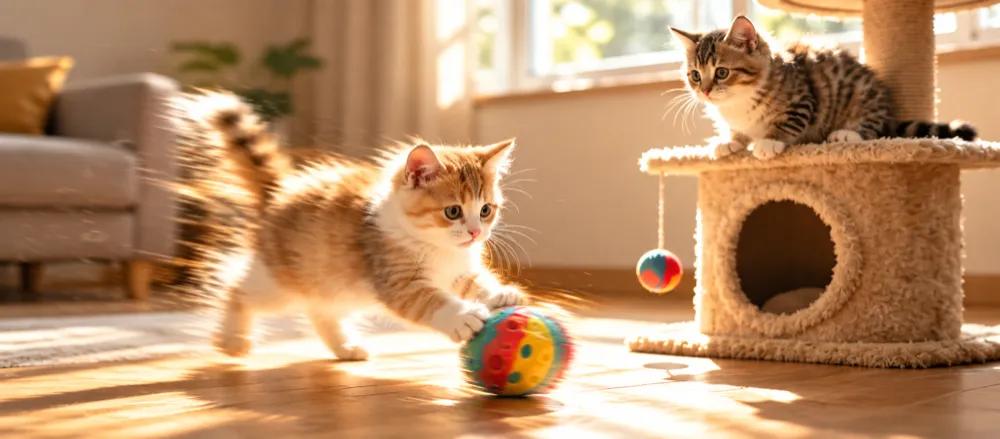
Once the cats are relaxed with scent exchange, encourage brief, supervised play on opposite sides of the closed dividing door. Use suitable toys and let each cat engage at its own pace. End the session before they lose interest, and put away string toys or parts that could be swallowed.
Persistent hissing or growling at the door means more separation is needed. Do not discipline the cat. You may need to close another door or use a barrier to create a neutral area in front of the dividing door, so the cats are not pressed up against that boundary.
Keep the door closed during this stage. The task is to support comfortable indirect interaction before moving on to seeing each other. Watch the cats throughout the session so you can respond to a change.
Let the cats explore separately
When the newcomer is settled in the transition room and all cats are comfortable with the earlier stages, secure the resident cats in a different room. Allow the newcomer a brief opportunity to investigate the shared areas of the home.
Return the newcomer to its transition room afterwards. Then give the resident cats the choice to use the shared areas again. The cats explore those spaces separately at this stage.
Manage the doors carefully so that alternating access stays separate. Before letting the newcomer out, confirm the resident cats are secured elsewhere. The transition room remains available for the new cat to return to when its time in the shared space ends.
Proceed only while the cats remain comfortable with what has already happened. If you are having difficulty managing the arrangement, ask for help before trying to combine stages.
Move to visual contact
After the earlier stages are comfortable, begin short periods of visual contact through a suitable secure barrier, such as screening or a glass door. Monitor both cats. If either becomes uncomfortable, stop and return to the closed-door and separate-exploration stages.
A tense crouch, flattened ears or hissing deserves attention. Reading both cats’ body language helps you consider those signals with the surrounding situation. Look at the cat that is retreating as well as the one moving forward.
Keep the first visual encounters short and supervised. The next stage depends on comfortable responses from all the cats. If they cannot remain comfortable while seeing one another through a barrier, continue working at an earlier stage.
Prepare for supervised meetings
Supervised close proximity comes after the cats are relaxed with visual contact. One arrangement uses cats already trained to a harness and lead. Another uses one cat already comfortable in a partially covered carrier while the other is allowed to investigate. Carrier training must happen beforehand. Do not introduce unfamiliar restraint equipment during the meeting.
Ask your vet for help choosing and preparing an arrangement you can manage safely. The cats need prior comfort with the equipment, and you need to be able to watch their body language throughout. If that preparation is incomplete, stay with the earlier stages.
Have a passive means of interrupting visual contact ready, such as a large piece of cardboard. Highly aroused cats should not be physically handled. Do not try to pick up a hissing cat or put your hands between the cats to separate them.
Keep suitable toys and rewards available during supervised proximity. Watch for a change in either cat’s response and be ready to interrupt the encounter safely. The arrangement should allow you to act without forcing contact with an aroused cat.
Know when to step back
Tension can be subtle. Staring, blocking and repeated avoidance matter alongside overt growling or swatting. Return to an earlier introduction stage when tension develops; continuing to advance despite those signals can contribute to lasting tension between the cats.
Chasing and wrestling can occur in both play and conflict. Consider whether the interaction is mutual and how the cats behave together at other times. If you cannot tell what is happening, seek veterinary help interpreting the encounter.
Comfortable encounters can gradually become longer, with supervision reduced as the cats learn to coexist without tension. Calm tolerance is an acceptable outcome. The cats do not have to groom one another or sleep touching to make the arrangement workable.
Arrange veterinary assessment if a cat’s behaviour changes. New hiding, reduced jumping or a changed routine may involve a medical problem as well as social tension. Keep that health assessment part of the response when introductions become difficult.
Questions about introducing cats
What warning signs should I watch for when introducing cats?
Watch for staring, blocking, avoidance or hiding, as well as hissing, growling and swatting. Return to an earlier stage when tension appears; you do not need to wait for a fight. Avoid physically handling highly aroused cats.
How much hissing is normal when introducing cats?
Hissing is a self-protective signal. Read it with the cat’s posture and the situation. Persistent hissing or growling at the door calls for more separation, without punishment. If tension develops during introductions, go back to an earlier stage and work from the cats’ responses.
Prepare the care records
Keep each cat’s medical records with its Nuzzy PetID for the pre-introduction vet discussion. Separate records help the family prepare the history for each cat.
Sources
- AAFP task force. 2024 AAFP intercat tension guidelines: recognition, prevention and management. Journal of Feline Medicine and Surgery (2024).
- Ellis SLH et al. AAFP and ISFM Feline Environmental Needs Guidelines. Journal of Feline Medicine and Surgery (2013).
- Quimby J et al. 2021 AAHA/AAFP Feline Life Stage Guidelines. AAHA guideline publication (2021).